|
The Arab
American Historical Foundation Holds its Third
Arab
American History Conference, November 1, 2008,
Hosted
by the Arab American National Museum,
13624
Michigan Avenue, Dearborn, Michigan 48126
The
Arab American Historical Foundation and the Arab American
National Museum proudly present the 2008 Arab American
History Conference. At this daylong conference, you’ll hear
about the latest research into Arab American historical
topics and meet the leading scholars from across the country
who are conducting those projects. Topics range from
familial oral history to current cultural trends.
Conference Schedule :
Welcoming notes by Joseph Haiek, Founder/President,
Arab-American Historical Foundation, and Dr.Anan
Ameri, Director, Arab American National Museum .
Oral, Familial and Communal
Histories: Moderator: Nadine Naber,
PhD, Presenters: Kathleen Marker: Identities in
Business: The Arab American Ethnic Economy James Goode: From
the Bekaa to the Grand: the Lebanese Community of Grand
Rapids, 1890-1940 Rosina Hassoun: The State of
Arab American Oral History Amy E. Rowe: Lebanese-American
memories alongside Arab American realities in rural New
England .
Media and Cultural
Representations: Moderator: Evelyn Azeeza
Alsultany Presenters: May Alhassen and Linda
Quiguivix: A Modern History of the “Keffiyeh Kraze”
Matthew Stiffler: Haflis, Camels and Hummus: Arab
Christians and Cultural Self-Representation in Bicentennial
America Geri Alumit Zeldes and Robert Albers: Caught
in the Cross Fire: Journalists and the American-Arab
Community in Detroit .
Lunch
and keynote speech : by award-winning author
Evelyn Shakir (winner of a 2007 Arab American Book Award
for Remember Me to Lebanon)
Organizations and Political
Engagements: Moderator: Thomas Abowd. Presenters:
John V. Bowlus: A Cedar Tree in America: Charles
Malik, the Lebanese American Community and U.S. Foreign
Policy in Lebanon ; Shaker Lashuel: The Evolution of
Yemeni-American Organizations from the 1950s to the Present.
Sunaina Maira: Arab American Youth in Silicon Valley:
The Politics of Community and Coalition Chapin. Li
Rydingsward: Modernity, Civilization and the Politics of
Arab American Anti-Zionism in the 1940s
Thomas Abowd has conducted several years of research in
Palestine and Israel. His interests relate primarily to
questions of colonialism and urban space more generally; the
effects of Israeli colonialism and military rule on occupied
Palestinian spaces more specifically; and the
“racialization” and reconfiguration of space in highly
contested cities under the weight of de-industrialization.
His new research project relates to the class and racial
encounters between Arabs and African-Americans in
contemporary Detroit. He is currently working on a book
related to racial politics in Detroit. Robert Albers is
Senior Video Specialist on the faculty of the Michigan State
University’s Department of Telecommunication. He has
produced and directed documentaries and has worked
extensively in public affairs programming for national and
international audiences, winning several awards. Albers is
also active as a consultant and independent
producer/director.
May
Alhassen is a historian, poet, racial and social justice
artist-activist, journalist, educator, co-host/producer for
ART America's What's Happening, and blogger for
KABOBfest.com. An American born to Syrian parents, she
recently earned a masters degree in anthropology from
Columbia University, with a thesis on Black-Arab Islamic
relations from the 1960s to the present day.
Evelyn Azeeza Alsultany is Assistant Professor of
American Culture at the University of Michigan, where she
teaches courses on Arab Americans, race, September 11th, and
media representations. Her current book project examines
racial profiling after September 11, 2001. She is a
guest curator at the Arab American National Museum. She was
honored with the Radius of Arab Writers Distinguished
Service Award in 2007.
John
V. Bowlus is a second-year doctoral student in
U.S.-Middle East diplomatic history at Georgetown
University. He focuses on U.S. foreign policy in Lebanon. He
received his M.A. from the University of Chicago in 2006 and
his B.A. from Brown University in 2000. He worked for a
non-profit organization in Beirut and served in the Peace
Corps in Senegal. James Goode has taught the history of the
Middle East at Grand Valley State University in Allendale,
Michigan for over 20 years. His book, Negotiating for the
Past: Archaeology, Nationalism and Diplomacy in the Middle
East, 1919-1941, was published in 2007. He recently
completed a manuscript on the history of the Lebanese
community in Grand Rapids, Michigan.
Rosina Hassoun holds B.S. and M.S. degrees in zoology
and biology from Texas A&M University and a Ph.D from the
University of Florida – Gainesville. She is a visiting
assistant professor at Michigan State University. Hassoun is
a poet and author of Arab Americans in Michigan (Michigan
State University Press). Her current focus is the study of
mitochondrial DNA in Yemeni Americans.
Shaker Lashuel, M.S. has worked as an educator for the
City of New York for the past decade. He is currently
pursuing his Doctorate of Professional Studies at Pace
University in the field of educational technology. Lashuel
has written more than 70 articles on Yemeni-American
community issues and has been an active community leader
within New York City’s Arab-American community.
Sunaina Maira is Associate Professor of Asian American
Studies at the University of California, Davis. She is the
author of Desis in the House: Indian American Youth Culture
in New York City and co-editor of Youthscapes: The Popular,
the National, the Global and Contours of the Heart: South
Asians Map North America, which won the American Book Award
in 1997.
Kathleen Marker is a Ph.D candidate in sociology at The
University of California, San Diego. Her dissertation is
focused on the overlap of religion and ethnicity in business
networking; she is presently conducting research among
Iraqi, Lebanese, and Palestinian business owners in
Dearborn, Michigan, seeking to understand how Arab American
business owners develop and use business networks.
Nadine Naber is an assistant professor at the University
of Michigan’s Program in American Culture and its Department
of Women’s Studies. She is co-editor of From Invisible
Citizen to Visible Subject: Arab American Engagements with
Race Before and After September 11th (Syracuse University
Press, 2007) and has published numerous scholarly articles.
Naber has co-founded several organizations including the
Arab Women's Solidarity Association, North America.
Linda
Quiguivix is a doctoral student in geography and
cultural studies at the University of North Carolina at
Chapel Hill. She explores questions of borders, states, and
capitalism. She is currently constructing counter-maps on
Palestine/Israel and the U.S./Mexico to highlight the
connections found within the politics and economics of
mobility and territoriality. She is a frequent writer for
KABOBfest.com.
Amy
E. Rowe is completing her Ph.D in Social Anthropology at
Cambridge University in England. In 2004 she was awarded a
Gates Scholarship in an international competition from a
trust established by the Bill & Melinda Gates Foundation to
support graduate research at Cambridge. Rowe received a B.A.
from Colby College in 1999 and an M.T.S. from Harvard
Divinity School in 2001.
Chapin Li Rydingsward is a Ph.D candidate in history at
the Ohio State University. His dissertation focuses on
American public discourse on Palestine from 1917-1948, with
particular emphasis on how that discourse shaped and was
shaped by the Arab and Jewish communities in the United
States.
Matthew Stiffler is a Ph.D candidate in American Culture
and Arab American Studies at the University of Michigan-Ann
Arbor. He examines the interplay of culture, politics, and
religion among Arab American Christians. He is part of a
national ethnographic project investigating the connections
between ethnic communities and scripture. Stiffler’s
research interests come from being raised in a Lebanese
Orthodox community in Johnstown, Pennsylvania.
Geri
Alumit Zeldes Ph.D is an assistant professor at Michigan
State University’s School of Journalism. She is a
qualitative and quantitative researcher intrigued by the
coverage of race and gender issues in TV and radio news
whose scholarly articles have appeared in several journals.
Prior to and during her doctoral studies at MSU, she was a
reporter and videographer for several local TV news stations
in Michigan and Indiana.
Conference participation:
Professional/Individual $25 .00; Student $10.00, Arab
American National Museum Membership (special reduced rate
for conference registrants) $15.00; Contact: The
Arab American National Museum Library & Resource Center,
Attn: Kristin LaLonde ,13624 Michigan Avenue,Dearborn,
Michigan 48126, (313) 582-2266.
Recommended Accommodations:
Doubletree Hotel Dearborn, 5801 Southfield
Expressway Detroit, Michigan 48228,Tel: (313)336-3340 Rate:
$99.00/night + tax (mention the Arab American History
Conference to receive this discounted rate.)
Arab
American National Museum The Arab American
National Museum documents, preserves, celebrates, and
educates the public on the history, life, culture, and
contributions of Arab Americans. It serves as a resource to
enhance knowledge and understanding about Arab Americans and
their presence in this country. The Arab American National
Museum is a project of ACCESS, a Dearborn, Michigan-based
nonprofit human services and cultural organization. Learn
more at www.arabamericanmuseum.org and
www.accesscommunity.org
The Arab American Historical Foundation
The Arab American Historical Foundation (AAHF) is dedicated to promote
research, preservation and dissemination of Arab-American history
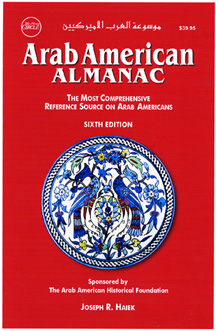
and culture. It was founded in 1978 in Los Angeles by Joseph R. Haiek, publisher of The News Circle/Arab American magazine and the Arab-American Almanac series. The AAHF
is a national non-profit organization under section
501(c)(3)
The AAHF Statement of Purpose:
- Research, preserve and disseminate the history of the Arab-American community in the United States of America;
- Hold lectures, conferences and exhibitions promoting the study of Arab- American history;
- - Launch awareness press campaigns urging Arab-Americans to preserve their historical resources, be it in English or Arabic, which currently are mostly scattered, neglected and many times discarded due to lack of evaluation and absence of professional historical services;
- Enhance awareness of Arab-American cultural values within the American society;
- Disseminating Arab-American historical findings, through the internet/website, special reports and essays distributed to researchers, scholars, the press, major educational institutions, students and the public to foster greater understanding of Arab-Americans and their contributions;
- Perpetuate, enrich and strengthen Arab-American history, correcting neglect and misinformation while bridging better understanding, cooperation and coordination;
- Provide literature and a forum for historical studies in a variety of disciplines;
- Establish and manage an Arab-American historical website
for worldwide accessibility.
Some of the AAHF accomplishments are:
- Co-sponsor research and production of the Arab-American Almanac, 5th edition, 560 pages;
- Launching an advertising campaign urging the Arab-American community to preserve historic documents, books, in English and Arabic, newspapers, photos, audio-video-film clips, correspondence, among others;
- Meet and discuss Arab-American historical affairs with American Historical institutions, scholars, Arab-American leaders and the press
- Publish the Arab-American Historian quarterly newsletter;
- Assist in archiving of The News Circle Publishing House 32 years editions of The Arab-American Affairs magazine and its collection of books by and about Arab-Americans, in English and Arabic, thousands of photos and audio-video clips.
AAHF needs your support:
The AAHF is supported by sponsors and friends, like you, who believe in its mission. Sponsorship is open to all, individuals, corporations, institutions, private, public foundations, and government agencies which provide needed support to materialize cultural/ethnic historical research
,preservation and dissemination programs. The AAHF is a
national non-profit organization under section 501(c)(3) of
the IRC.
Direct all inquiries, historical suggestions, contributions, and mail Arab American historical comments and article submissions to:
Arab American Historical Foundation
P. O. Box 291159
Los Angeles, CA 90029, U.S.A.
Phone: (323) 466-8900, (818) 507-0333, Fax: (818) 246-1936 |